Kazakhstan's nuclear industry has a long and rich history, beginning in the Soviet period and continuing to the present day. Below is a timeline of key stages in the industry's development: from the first uranium deposits and research reactors to the launch of the modern nuclear energy program.
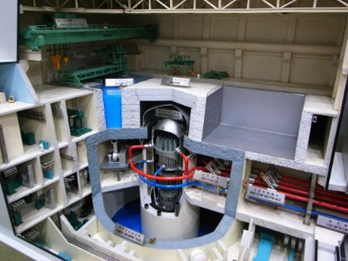
A nuclear reactor is a facility where a controlled chain reaction of uranium fission takes place.
How it works:
Fuel (uranium rods) splits, releasing heat
Water in the reactor heats up and turns into steam
Steam rotates a turbine connected to a generator that produces electricity
After that, the steam cools down and is reused in the cycle
Electricity is supplied to the city through power lines
Reactor safety is ensured by multi-level protection systems, such as a double hermetic shell, a combination of passive and active protection systems, including a cooling system and emergency shutdown.
The reaction rate is regulated by special control rods — they absorb excess neutrons.
Working principle: nuclear energy is converted into heat, and then into electricity.
Types of Reactors Considered for Kazakhstan
Below are the main types of reactors being considered as possible options for the construction of a nuclear power plant in Kazakhstan.
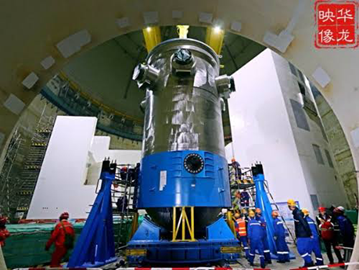
Water-Water Reactor (VVER-1200, Russia)
Generation: III+
Developer: Rosatom (Russia)
Thermal capacity: 3300 MW(th)
Electric capacity: 1200 MW(e)
Core: 163 fuel assemblies
Scheme: four-loop
Fuel cycle: 12–18 months (extendable)
VVER combines active and passive safety systems, ensuring stable operation even in case of loss of external power supply. The design complies with IAEA international standards for generation III+ plants.
Deployed: Russia, Belarus
Under construction: Egypt, Bangladesh, Hungary, China
Pressurized Water Reactor (HPR1000, China)
Generation: III+
Developer: CNNC (China)
Thermal capacity: 3050 MW(th)
Electric capacity: 1200 MW(e)
Core: 177 CF3 fuel assemblies (UO₂)
Scheme: three-loop
Fuel cycle: 18 months (extendable)
HPR1000 combines active and passive safety systems.
Deployed:
China — Fuqing-5, Fuqing-6, Fangchenggang-3, Fangchenggang-4, Zhangzhou-1
Pakistan — Karachi-2, Karachi-3
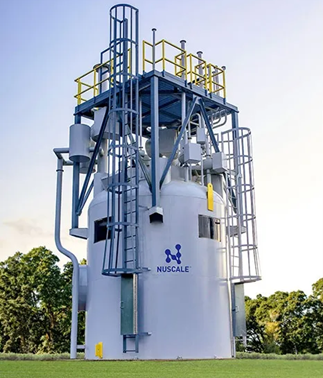
Small Modular Reactor
Reactors up to 300 MW as defined by IAEA
Modular design, low power and high safety
Equipped with passive safety systems and simplified design
First SMRs in operation: floating NPP Akademik Lomonosov (Russia) and HTR-PM (China, 210 MW)
Considered a promising solution for remote and Arctic regions
Over 80 SMR concepts currently under development
Key nuclear energy terms in brief. Click a card to read more and watch a video.
An atom consists of a nucleus (protons and neutrons) and electrons around it. Almost all of its mass is in the nucleus, which stores the enormous energy used by nuclear power.
Uranium is a heavy metal found in the Earth’s crust. Reactors use uranium enriched in the uranium-235 isotope to 3–5%. Kazakhstan is the world leader in uranium mining (about 40% of global output).
A nuclear reactor is a facility where a controlled chain reaction of uranium fission takes place. The heat produced boils water, the steam spins a turbine and a generator produces electricity. Power is controlled by neutron-absorbing rods.
Radiation is always around us — from space, rocks, even food. What matters is the dose. The average annual natural dose is about 2.4 mSv; an operating NPP adds less than 0.01 mSv.
Isotopes are atoms of the same element with different numbers of neutrons. Uranium-235 fissions easily and serves as fuel, uranium-238 does not. Isotopes are also used in medicine for diagnosis and treatment.
Fuel consists of thimble-sized uranium dioxide pellets stacked in sealed tubes (fuel rods) and assemblies. One pellet gives as much energy as about a tonne of coal. Fuel is replaced every 12–18 months.
A nuclear power plant converts the energy of nuclear fission into electricity. It works like a thermal plant, but instead of burning coal or gas, the heat comes from a reactor — with no CO₂ emissions.
A thermal plant burns coal or gas, emitting CO₂, ash, sulphur and nitrogen oxides. An NPP burns nothing and runs steadily 24/7 regardless of weather. It needs tens of thousands of times less fuel by mass.
VVER is a reactor in which ordinary water serves as both coolant and moderator. The VVER-1200 is a Generation III+ design with passive safety systems and a core catcher.
SMRs are reactors of up to 300 MW assembled from factory-built modules. They suit remote areas and small grids, are faster to build and need less upfront investment.
Hover over or tap an element of the diagram to see the explanation.
Target energy mix (illustration)
CoalGasNuclearHydroRenewables
Shares are indicative and illustrate the principle of a balanced energy mix.
Key figures of the first NPP project. Values are updated via the admin panel.
2 400MW
Installed capacity
Test value
≈ 19TWh
Annual electricity output
Test value
60years
Service life
Test value
10 000people
Construction jobs (peak)
Test value
2 000people
Operation jobs
Test value
TBD
Investment
Test value
2029–2035
Construction period
Test value
≈ 15Mt
CO₂ emissions avoided per year
Test value
up to 30%
Local content share
Test value
Updated
:
Myths and Facts about NPPs
Common myths about nuclear energy and brief facts that counter them.
Myth: Living near a NPP is dangerous — it emits radiation
Fact: The radiation dose from the plant is minimal and safe.
Myth: A NPP can explode like Chernobyl
Fact: Modern reactors have multi-level protection — automatic shutdown, passive cooling, hermetic containment. The risk of an accident does not exceed 1:10 million per year.
Myth: Radiation contaminates food and air
Fact: All emissions and waste are under strict control, the external environment receives no contamination.
Myth: Working at a NPP is harmful
Fact: Personnel are protected, the exposure level is significantly below international standards.
Myth: Any radiation is deadly
Fact: Radiation is a natural part of nature. Small doses are safe for humans.
Myth: NPPs harm the environment
Fact: Nuclear plants do not emit CO₂ and are considered an environmentally friendly energy source.
Myth: A NPP can fail during an earthquake and cause bad consequences
Fact: Safety systems of modern NPPs are designed for earthquakes up to magnitude 9 and can shut down the reactor without threat to the environment.